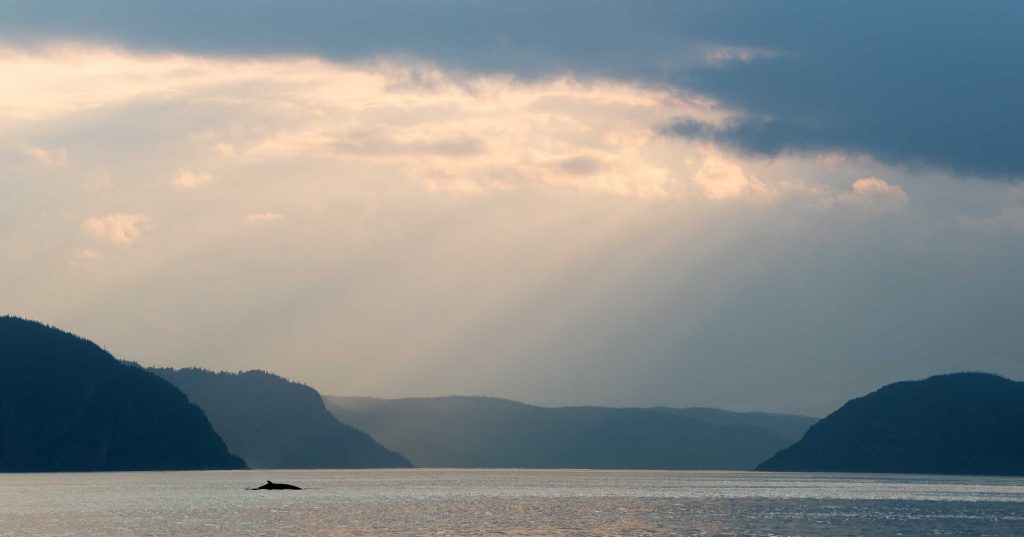
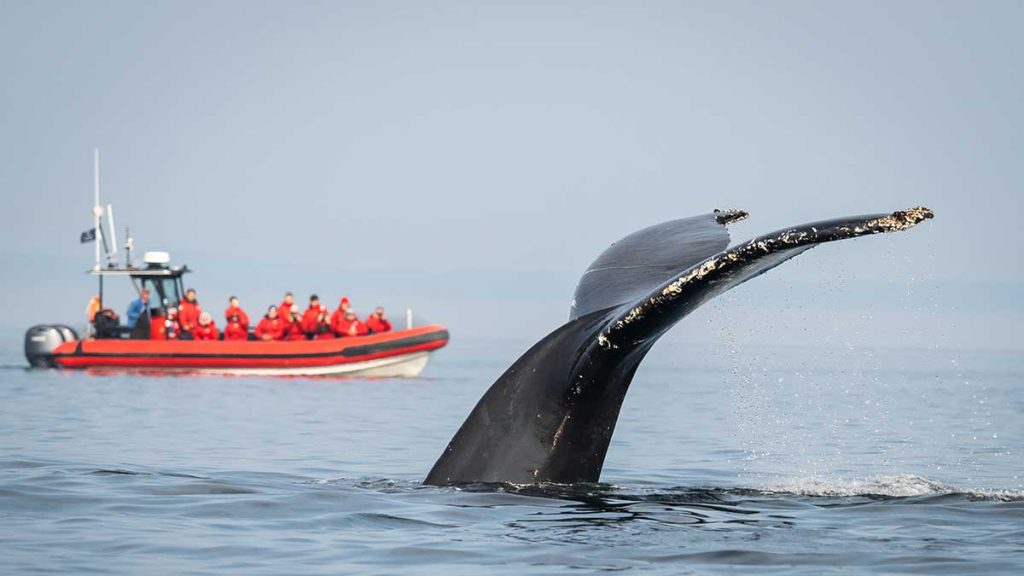
In 2025, numerous initiatives contributed to preserving the Marine Park’s ecosystems while promoting educational, recreational, and scientific activities. Thanks to work carried out on several fronts, this year was marked by significant progress made in collaboration with many partners. This retrospective invites you to revisit the highlights of the year. Throughout the sections, explore the results obtained and see how, together, we contribute to the protection and enhancement of the Saguenay–Saint-Laurent Marine Park.
Highlights of 2025
Agrandissement
Expanding the Saguenay–St. Lawrence Marine Park
In March 2025, the governments of Canada and Quebec confirmed their commitment to expand the Saguenay–St. Lawrence Marine Park. Following targeted and public consultations, the findings are clear: the project has consensus and the proposed area for expansion has very strong public support. The expansion of the Marine Park aims to significantly enhance the protection of the St. Lawrence estuary and to include all of the beluga’s essential habitat.
The Marine Park will be officially expanded when the new boundaries are included in the Marine Park’s founding legislation. This process could lead to results in the coming year. Once expanded, the marine protected area will cover nearly 4,500 km2.
Halte du béluga
A revamped Halte du Béluga
In August 2025, the Parc national du Fjord-du-Saguenay unveiled the new Halte du Béluga in the Baie–Sainte-Marguerite area.
Anchored on the rocky cape, this infrastructure has been completely renovated and enhanced. In addition to the existing lookout, the rest area now includes an amphitheatre, a free observation area, and a picnic spot. A new spacious area, completely dedicated to the beluga research teams, has also been set up on the second floor.
Nat geo
International distinction
In October 2025, the Saguenay-St. Lawrence Marine Park was mentioned in the National Geographic article series “Best of the World 2026”. Selected among the four must-see destinations in Quebec, it has been recognized as an exceptional place for whale watching.
This distinction also highlights the conservation efforts made to better coexist with marine mammals. With this international recognition, the marine park is honoured to be mentioned alongside partners such as Du Fleuve, the Marine Mammal Interpretation Centre (CIMM), and the Putep ’t-awt widow’s walk.
Nettoyages
A summer marked by beach cleanups
About twenty shoreline cleanup activities have been carried out on the shores of the Marine Park and its surroundings. This collective effort mobilized over 300 volunteers around a common goal: to clean our shorelines and fight plastic pollution.
In total, 4,998 kg of waste was removed, which is equivalent to the weight of about five belugas. Many schools, municipalities, and engaged citizens have participated in these cleanups with the support of several environmental agencies. Thank you all!
Des écoles, des citoyens engagés, des organismes de bassin versant et d’autres organismes environnementaux ont participé et organisé les nettoyages. Merci à tous et à toutes!
Visiteurs
Visitors were there!
As anticipated by the tourism industry, the regions of Quebec were very popular with vacationers in 2025.
Several sites located along the Marine Park have even set attendance records, particularly the centres managed by Parks Canada. Thanks to the free admission offered during part of the summer, these facilities welcomed 99,131 visitors, setting a new attendance record. This figure represents a 40% increase compared to 2024, confirming the growing attraction of the park and its surroundings.
Premieres nations
Indigenous Guardian programs rooted in action
Several promising projects for the protection and management of marine environments have been carried out with the Wolastoqiyik Wahsipekuk First Nation and the Essipit Innu First Nation.
In November, the Wolastoqiyik Wahsipekuk First Nation celebrated the sixth edition of the Wahsipekuk Seminar, strengthening its members’ ancestral connection to the Wolastokuk. For the Essipit Innus, 2025 marked the first official year of monitoring lobster and eelgrass beds. The purpose of this monitoring is to ensure the sustainability of their traditional fishing and conservation of their sites. These projects were carried out with support from Parks Canada as part of Indigenous Guardian programs.
Rorquals
The low number of large rorquals explained by research teams
Summer 2025 revealed a decrease in the number of large rorqual sightings in the marine park. To find out more about this situation, the Research and Education group on Marine Mammals (GREMM) and Parks Canada published two articles on Whales Online regarding the theories that resulted from ongoing research work.
The project for monitoring pelagic prey and their predators did not identify any large schools of fish, while large numbers of krill were irregular. The variation in the amount of prey fits with data on large rorqual numbers in the estuary. To find out more, take a look at the first part and second part of this report.
Mieux cohabiter
Launch of the “Sharing the waters with Belugas” narrative map
The story of the “Sharing the waters with Belugas” project details the efforts made by Parks Canada and its partners to quiet down the beluga’s habitat.
Action taken with communities has improved how we can navigate through the four areas of the park and keep them quieter. All of the completed work is detailed and illustrated using a narrative map that is accessible online.
Scientific monitoring and research
Projects are counted based on the number of subjects studied under each research permit issued by the Marine Park.42 permits were active in 2025.
The most studied topics
Marine invertebrates
Marine mammals
Coastal habitats and bank erosion
Research organizations
Distribution of projects across the park
Tourism and presentation
22 coastal locations, including wharves, hiking trails with exceptional viewpoints, as well as museums and interpretation centres.
Awareness and training for the protection of marine mammals
1,311 people have been made aware of good navigation practices in the marine park.
Specifically, it is through:
The training of kayak captains and guides under the Marine Activities in the Saguenay – St. Lawrence Marine Park Regulations. Passing the annual exam is mandatory for all pilots and guides of marine excursion companies.
The meeting of boaters in the marinas and launch sites along the park.
Targeted at-sea awareness patrols during the beluga calving season.
Participation in conferences to present ways to navigate whale habitats.
Explore this interactive map to find out about the events our teams participated in this year.
A total of 10,565 people were engaged in activities to raise awareness about the ecosystems and ways to protect them, such as festivals, public events, virtual activities, and conferences.